Knee Pain on the Stairs

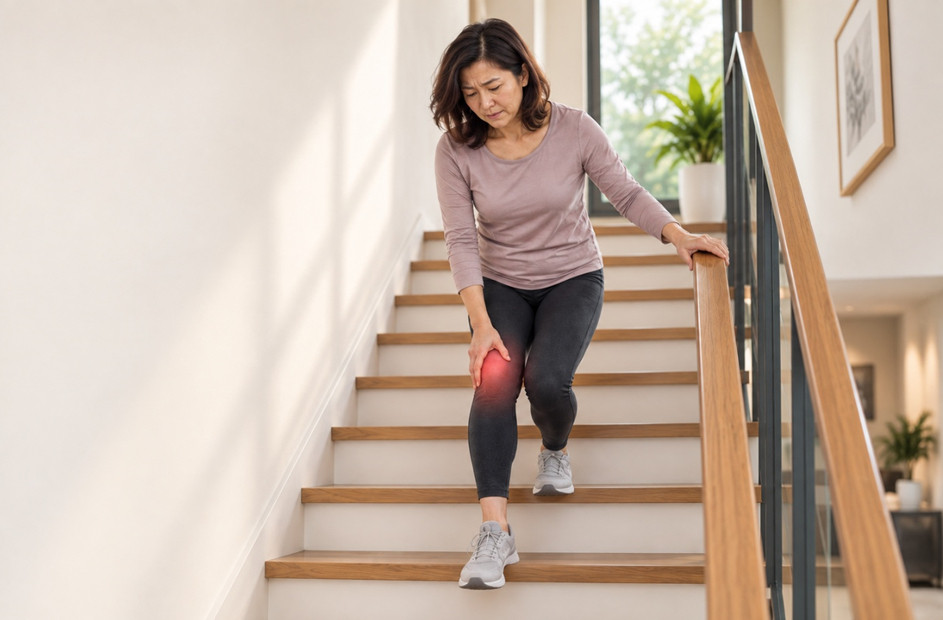
A broken escalator at the airport shouldn’t feel like a problem. But when your knee has been bothering you, that staircase beside it can suddenly feel like a lot of work.
You might find yourself looking around for a lift, slowing down on the steps, or putting more weight through one leg without even realising it. Over time, these small adjustments can become part of your everyday routine.
We see this often in the clinic. Some people notice it after hiking or exercising. Others first realise something is wrong when climbing the stairs at home, at work, or at the MRT station.
Stairs naturally place more demand on the knees than walking on flat ground. So when your hips, knees, ankles or surrounding muscles aren’t moving and working together as well as they should, stairs can be one of the first places you notice it.
And the knee itself may not always be the whole story.
The way your hips move, how your feet land, your ankle mobility and the strength of the muscles supporting your legs can all affect how much stress reaches the knee with every step.
That’s why simply focusing on the painful area may not be enough. Looking at how the whole lower body moves can give us a much clearer idea of what is causing the problem and what can be done to improve it.
The "Why": Up and Down Aren't the Same Problem
Here's something that surprises a lot of patients: pain going up the stairs and pain going down the stairs usually point to two different root causes.

Climbing up requires your quadriceps and hip muscles to contract forcefully to lift your entire body weight onto the next step. This is a lot of concentric work, muscles shortening under load. If your kneecap isn't tracking smoothly in its groove (a condition often nicknamed "runner's knee," or patellofemoral pain), or if your quads and glutes are weaker than they should be, that extra demand shows up as pain, grinding, or a feeling of instability right around or under the kneecap.

Walking down, on the other hand, is a braking movement. Your muscles are working eccentrically, lengthening while under tension to control your descent and absorb impact with every step. This is why going down often feels worse than going up for a lot of people. Downstairs pain more frequently points to issues like meniscus irritation, cartilage wear behind the kneecap, or instability further down the chain, such as a hip or ankle that isn't stabilizing the way it should, forcing the knee to absorb forces it wasn't built to manage alone.
Neither of these is something you just have to live with. But treating them well means understanding that the knee is often the messenger, not the source.
The Chiropractic Connection: It's Rarely "Just the Knee"
The knee is a hinge joint. It's designed to move in one primary plane, forward and back. It has very little ability to correct for problems happening above or below it. That means if your pelvis is rotated, one hip is sitting higher than the other, or your spine's alignment is subtly pulling your posture off-center, your knee ends up compensating for it with every single step you take.
This is where a lot of stair pain quietly builds over time. A hip that isn't moving symmetrically changes how your femur rotates. A pelvis that's tilted changes how weight travels down through your leg. An ankle that lacks mobility can force your knee to twist slightly to make up the difference. None of these show up as "hip pain" or "back pain." Instead, they show up as knee pain, because that's the joint stuck doing the compensating.
This is exactly why a chiropractic evaluation looks beyond the knee itself. By assessing alignment and movement through the spine, pelvis, and hips, we can often identify the upstream cause of poor tracking and uneven loading, the actual reason your knee is under so much stress in the first place.
3 Things You Can Try at Home Today

Check your foot placement and lead with control, not speed. Going down, place your whole foot on each step rather than just your toes, and resist the urge to hurry. A slower, controlled descent reduces the sudden braking force your knee has to absorb.

Strengthen your glutes, not just your quads. Weak glutes are one of the most common hidden
contributors to knee pain, since they stabilize your hip and control how your femur rotates. Simple glute bridges or standing hip abduction exercises, done a few times a week, can meaningfully improve how your knee tracks on stairs.
Use the right recovery tool for the right moment. As a general rule, ice calms down an acute flare-up or swelling (10–15 minutes after activity), while heat helps loosen a stiff, achy joint before activity. Neither replaces addressing the underlying cause, but both can make daily life more comfortable while you work on it.
For a longer-term strategy, low-impact strengthening, think step-ups, controlled step-downs, and hip-focused exercises, helps build the resilience your knee needs to handle stairs without protest. The goal isn't to avoid the stairs forever; it's to build a body that can handle them again.

Ready to Find the Real Cause?
Knee pain on stairs is common, but "common" doesn't mean it's something you should just manage around for the rest of your life. If your knee has been holding you back from stairs, hikes, or simply moving through your day with confidence, it's worth finding out why, not just treating where it hurts.
Schedule a comprehensive knee and spinal assessment at our clinic today. We'll take a full look at your hips, pelvis, spine, and knee mechanics together, so we can get to the actual root of your pain and build a plan to help you climb, and descend, without a second thought.